Friday, 23 January 2015

Keele Refugee Week 2015 Call for Events

It may be five months away but we are already gearing up for Keele Refugee Week 2015!

‘Refugee Week is a UK-wide programme of arts, cultural and education events and activities that celebrates the contribution of refugees to the UK and promotes better understanding of why people seek sanctuary’ (Refugee Week 2015).

Last year Keele University joined Refugee Week for the first time by hosting a weeklong photographic exhibition, an opening event with a musical performance and a poetry open mic night organised by students. This was co-organized by staff and students in the Faculty of Humanities and Social Sciences, including Siobhan Holohan and Ala Sirriyeh from Sociology.


Following on the success of last year, Keele Refugee Week 2015 we are now gearing up to host an even richer week of events. We are therefore calling on individuals, departments, Schools, Faculties, Societies (KSU), students’ groups or community groups who are working with (or would like to establish links with) a group in the university, to submit proposals for a variety of events to be held during Keele Refugee Week 2015 (8-14 June). Write to us with any ideas for events you wish to organize within Refugee Week! Events should be relevant to the ethos of Refugee Week (for more info see http://www.refugeeweek.org.uk/).

Ideas for events include (but are by no means limited to):
• Poetry, drama, creative writing
• Debates, public lectures, Q&A sessions
• Art exhibitions
• Lectures and workshops
• Music performances, dance
• Film screenings
• Children activities
• Storytelling
• Open mic sessions
• Events already planned within your yearly activities which may ‘fit’ within
Refugee Week
• Any other ideas you may have
• See also the national website for Refugee Week 2015 which has many more examples of events you could hold (http://www.refugeeweek.org.uk/)

“Keele Refugee Week 2015” organising committee* provides a framework to build in and timetable events across the university, it offers advice to anyone willing to put up an event, and it produces the overall marketing and publicity materials for the week. Keele Refugee Week does not cover any costs or provide funding.

Please submit your event suggestions to events.refugeeweek@keele.ac.uk by Monday 16th February 2015. Please include your name, affiliation, contact details and a brief summary of your proposed event (max 1 page). In proposing the event, think about the following: venue, resources, costs (if there are any).

We look forward to receiving your proposals.

The organising Committee:

Jon Granger (President KPA)
Bolu Oyewale (President KSU)
Mariangela Palladino (Lecturer, English)
Annie Piper (Vice President KSU)
Ala Sirriyeh (Lecturer, Sociology)


Wednesday, 14 January 2015

New paper by Ala Sirriyeh on class and the new UK family migration rules

In July 2012 the Conservative–Liberal Democrat Coalition government introduced a new set of family migration rules. These rules set a sharp increase in the minimum income threshold for people sponsoring partners and children to join them in the UK. Consequently, there has been a significant reduction in the number of visas granted through the family migration route.

The journal Critical Social Policy has just published an article I have written which examines these new rules. The article is called ‘‘All need is love and £18,600’: class and the new UK family migration rules’ and started life as a post last year on this blog. This article explores the themes of class in connection to transnational relationships and citizenship in the formulation of the new family migration rules, in the justifications that have been made for the rules and in the impact of the rules on applicants. It is argued that in the context of international migration and transnational relationships, class-based moralism and regulation has been entwined with exclusionary discourses on ethnicity, national belonging and citizenship and has been extended beyond the nation-state border towards the governing of particular kinds of international family.


NB/ The quote in the title of the article is a slogan that has been used by campaigners protesting against the impact of the new rules on families living apart.

Friday, 12 December 2014

Botswana Democracy ignored by the Global Media by Pnina Werbner

Pnina Werbner is Professor Emerita in Anthropology at Keele University and author of The Making of an African Working Class: Politics, Law and Cultural Protest in the Manual Workers' Union of Botswana (Pluto Press 2014).  In this post Pnina considers how Western ‘bad news’ perspectives on Africa disguises the strength of civil society and trade unions in protecting democracy and the public interest.

Botswana is the oldest, fully functioning democracy in Africa. You would never guess it, however, by the way in which the country is ignored by the western – and global – media. Bad news travels far and fast in Africa – the Ebola epidemic, kidnappings, civil wars, massacres, dictatorships, rigged elections, all make headline news. If Botswana is mentioned, it is in relation to the HIV/Aids epidemic or the dispossession of Bushmen. Not so, however, when it comes to holding free and fair elections or the defence of the Constitution by an independent judiciary.

About the same time Botswana held its elections for a new Parliament, on 24 October 2014, there were runoff presidential elections in Brazil, won by Russeff, and national elections in Tunisia, won by its secular party. These were clearly important events of undoubted significance for the West. Botswana’s elections were not even mentioned, let alone analysed, yet they too were something of a watershed. For the first time in the history of Botswana, a united opposition alliance, the Umbrella for Democratic Change (UDC), almost won. The ruling party, the Botswana Democratic Party (BDC) which had repeatedly won all the elections since independence, in 1965, got only 46% of the vote, though it gained 37 of the 57 parliamentary seats in a first-past-the-post electoral system. The cause of the opposition’s failure was a small party, the Botswana Congress Party (BCP), which had shortsightedly refused to join the main opposition alliance, thus splitting the vote in many constituencies. But the writing was clearly on the wall for the Botswana establishment: young people and city dwellers were fed up with the status quo, which had led to allegations of cronyism, corruption, secret surveillance and ‘tendrepreneurship’(corruption in awarding public contracts), emanating in the popular view from presidential autocracy.
Cartoon of President Khama tied to a tree

Despite his alleged autocracy, however, the President, Lieutenant General Ian Khama, was a democratic, publicly committed to giving up his office lawfully after two terms, as spelled out by the Constitution. This would mean, in effect, passing the presidency onto his Vice-President mid-term, as had happened when Khama himself became President. African presidents are known for their repeated attempts to extend their constitutional rights to office, clinging on to power come what may. In the case of Khama, the prevailing rumour was that he intended to appoint his younger brother to the vice-presidency, despite the latter's political inexperience and lack of popularity. In the local press, headlines proclaimed Khama's ambition to create a 'dynasty'. This led to a series of cliffhangers which tested Botswana's democracy as never before.

Unionist leaders in front of the High Court and
Court of Appeal Building
Before Parliament was dissolved it passed a ruling allowing for the election of the Vice-President, the Speaker of the House and the Deputy Speaker in parliament by secret ballot. After the elections, the President, through the office of the Attorney General, challenged this ruling in the High Court and later the Court of Appeal. The accepted view was that an open ballot would allow him to intimidate members of his own party, despite the widespread feeling, reported in the press, that elected parliamentary members of the BDP strongly objected to the nomination of the President's brother.
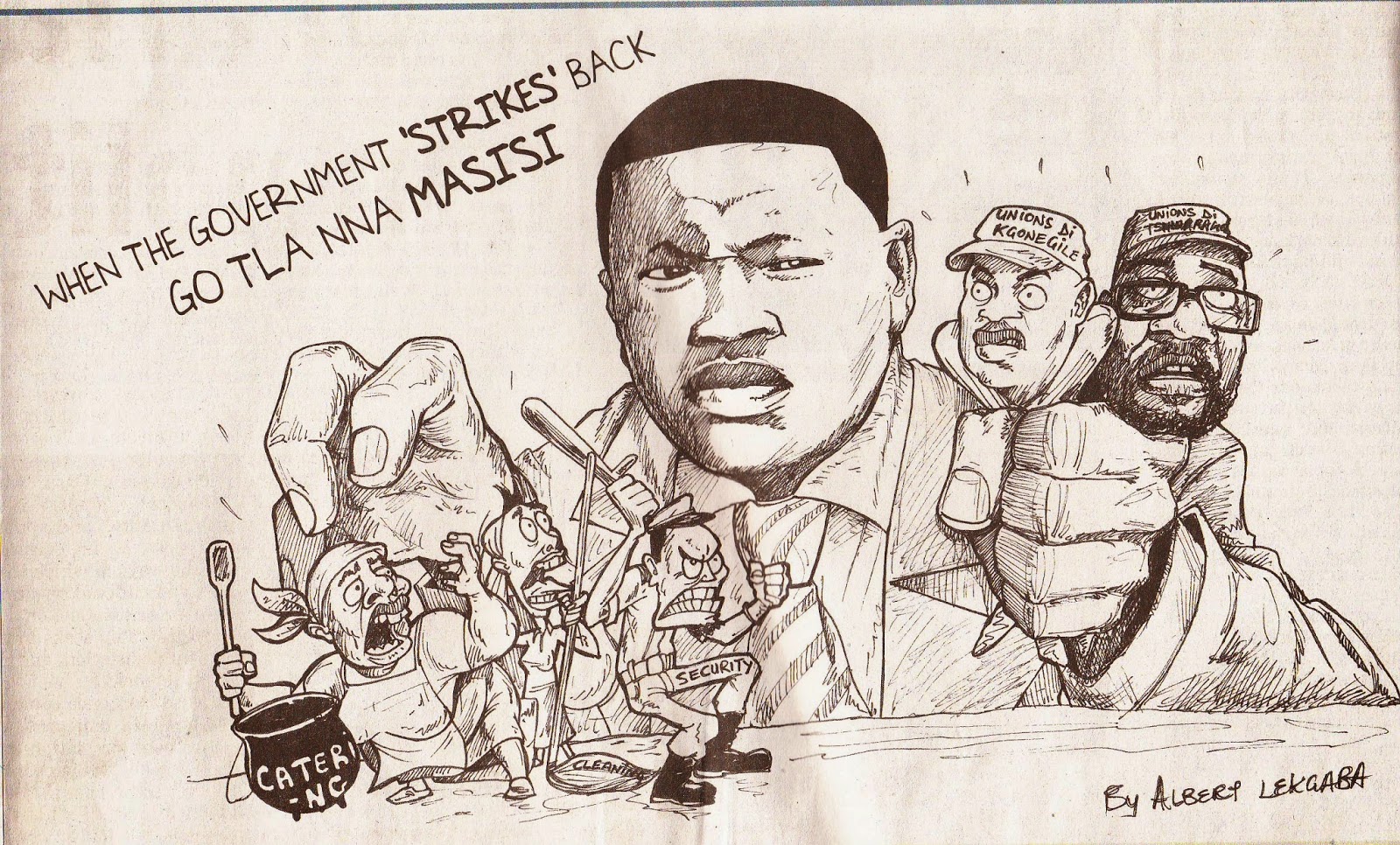
Cartoon of Masisi, now Vice-President, oppressing workers
As always in Botswana, the whole nation mobilized in anticipation of the court verdicts, crowding into the court, crammed wall to wall, packing the corridors. When the dismissal of the presidential challenge by the High Court bench of five judges was announced, it was greeted with ululations and a general sense of relief. The Attorney General managed, however, to get the appeal of the ruling heard on an urgent basis in the Court of Appeal, the highest in the land. Could the President of the Court of Appeal, Justice Ian Kirby, a conservative judge and long-term friend of the President, be trusted to defend the common good of the nation? At stake was the independence of the judiciary in Botswana. The whole country held its breath. When the Court of Appeal, presided over by Kirby, supported the verdict of the High Court the nation breathed a sigh of relief. Botswana democracy had been redeemed, with the Constitution safeguarded by the judiciary. In the event, the candidate selected for the Vice-President , Mokgweetsi Masisi, was an unrelated long-term politician, voted in by the ruling party unanimously in Parliament in a secret ballot.

Duma Boko, leader of the Opposition, speaking to
public sector union strikers
As in Tunisia and Brazil, the struggle and mobilisation by trade unions against inequality played a major part in this unfolding saga.  In Botswana, the public sector union federation (BOFEPUSU) in particular worked hard to create a unified opposition alliance. As I document in my recent book, The Making of an African Working Class (Pluto 2014), the unions urged and agitated the opposition parties, while taking the government constantly to court in judicial review, thus charting the way to legal activism and the demand for justice.

The global media's myopia with regard to Botswana is particularly short-sighted at a time when new democratic regimes in Africa are growing in confidence and strength. It would seem to be the duty of the media to support these nascent African democracies, and at the very least report on their struggles, rather than engaging merely in tired Afropessimistic reportage.

Tuesday, 9 December 2014

Research training award for Nicola Edwards

Congratulations to Nicola Edwards, a student on the MA in Criminology and Criminal Justice programme at Keele, on being awarded a fully funded place on a 3-day research training school in Barcelona in January.  The training school is run by a European intergovernmental organisation called COST (Cooperation in Science and Technology) which encourages research collaboration across Europe and the theme of the school is 'Offender Supervision in Europe'.  Nicola graduated from Keele this summer with a first class honours degree in Criminology and Sociology and she is continuing her research by combining her commitment to working with offenders with her interest in street art and 'visual criminology'. In Barcelona, Nicola will get the chance to present her research to European experts and to receive tuition on her future research plans.  She has agreed to write a blog when she gets back, so watch this space!